
Climate change will negatively affect Central Asia's ability to grow its own food
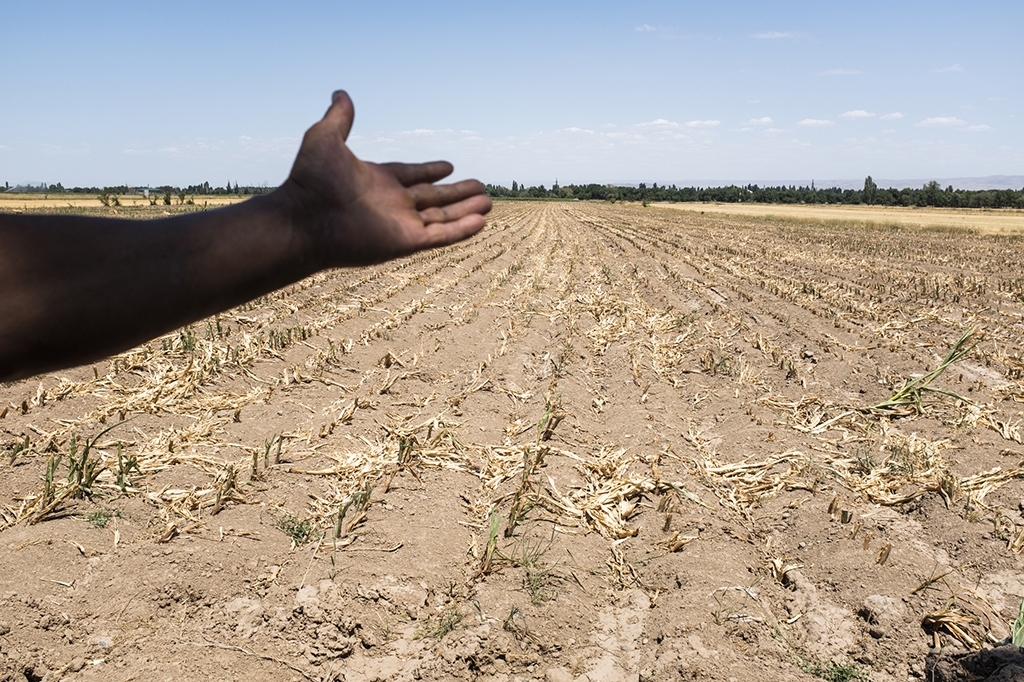
Global warming will lead to sharper changes in daily and seasonal temperatures, an increase in the number of extreme weather events, changes in climate zones and agricultural epidemics of invasive fungi, bacteria, viruses and insects provoked by these factors. This will negatively affect Central Asia's ability to grow its own food. Such a disappointing forecast for the future was made by the scientific consultant of the Central Asian Climate Fund (CACF), Doctor of Biological Sciences, member of the Cambridge Forum on Central Asia Temur Yunusov.
All types of organisms are distributed across climatic zones. Any small changes in weather conditions in an individual region or on the planet as a whole affect the biosphere. The current problem of climate change is caused by the explosive technological development of mankind and proceeds much faster than organisms are able to adapt to its consequences. Moreover, the amplitude of climate change in some cases exceeds the biological thresholds of survival, i.e. it is impossible to adapt to them.
«When it comes to survival in extreme conditions, the most important thing is to prioritise critical needs. And the order of these needs is determined based on how quickly the lack of a particular need can kill a person. On average, in extreme conditions, a person is able to survive up to a week without food, three days without water, but only a few hours without shelter. Both heat and cold can kill a person much faster than lack of water or food. Therefore, in extreme conditions, the first priority is always to find refuge from adverse environmental conditions, primarily extreme temperatures, then look for water and food. Only the right priorities give a chance for survival», Temur Yunusov emphasized.
In the face of climate change caused by global warming, in Central Asia, first of all, it is necessary to provide protection from extreme temperature and weather. The region as a whole is characterized by a pronounced continental climate, which means extreme temperature changes even during the day, not to mention annual changes. For example, temperatures in the UK average between 25C in summer and around -7C in winter, an annual drop of 32 degrees. In the desert regions of Central Asia, a daily temperature difference in the summer from 47 °C during the day to 15 °C at night (32 degrees) is the norm.
According to the expert, it is very difficult to accurately predict how global warming will affect Central Asia, because this is an unprecedented climate change that is happening much faster and with a greater amplitude than it was before.
«However, in general, it can be argued that an increase in global temperatures will lead to more extreme changes in daily and seasonal temperatures, an increase in the number of extreme weather events such as frosts, hail, heavy rains, mudslides and landslides, droughts and fires, changes in climate belts and agricultural epidemics of invasive fungi, bacteria, viruses and insects provoked by these factors.
Under these conditions, agriculture will be the first to suffer, which will have a negative impact on the region's ability to grow its own food. This will not necessarily lead to mass hunger in Central Asia, because in the modern world trade is well developed, which allows you to buy food abroad. However, an increase in the share of imports will definitely lead to higher food prices and higher inflation. Moreover, this puts the region in food dependence on other countries», said Temur Yunusov.
The CACF scientific adviser is confident that ensuring food security is a key function of all governments, because without it is impossible to support the population and, accordingly, the state.
«Extreme temperatures are the initial cause of deteriorating agricultural productivity, loss of glaciers and the increasing costs of providing acceptable temperatures for the public. To protect against the effects of climate change, it is necessary to act on the same principles of survival – first of all, to protect the key functions of the state from extreme temperatures and weather events. Central Asia in general and Kazakhstan in particular are able to prepare their agriculture for the upcoming climate changes and/or transfer most of the agricultural land to the northern regions», the expert emphasized.
Temur Yunusov believes that it is important for people to realize that climate change is caused and more supported by human activities. Minimizing carbon dioxide emissions into the atmosphere can affect the speed and strength of global warming. As an example, we can cite many positive changes in ecosystems around the world during quarantines in 2020-2021.
«Geopolitical destabilization in the major oil and gas producing countries is already causing an economic downturn and rethinking of the development strategy in various states. Europe is striving to become the first electric continent, China is already the leader in the ever-increasing share of renewable energy sources in the world, India, the countries of North Africa and Latin America are also striving to reduce dependence on fossil energy sources. This means that in the future, Central Asia and Kazakhstan in particular will not be able to find the same rich market for oil and gas. If Kazakhstan does not rebuild the basis of its economy, then climate change can negate revenues from the oil and gas industry», the CACF scientific consultant summed up.
Recall that from November 9 to 20, 2026, Antalya (Turkey) hosts the 31st Conference of the Parties to the UN Framework Convention on Climate Change (COP31). The summit is attended by delegations from 197 countries, including heads of state, ministers, scientists and representatives of non-governmental organizations.
Key topics COP31
• Switching to Renewable Energy: Discussing global targets to increase the share of electricity from renewable sources to 35% by 2035.
• Moving from declarative climate commitments to practical and measurable solutions.
• Discuss energy, transport, agriculture and climate change adaptation measures.
• Sustainable Cities: Presentation of Turkish experience in building disaster-resilient cities and eco-city concepts.
• Regional initiatives: a meeting of the Ministers of Ecology of the countries of Central Asia to discuss climate threats and water resources, as well as the work of national pavilions.
The National Pavilion of Kazakhstan brings together the state, business, science, civil society and international partners to discuss how climate commitments are turning into real projects in Central Asia - from water and energy to finance, cities and youth.
