Logo RES 02

One region, one vision, one future

Visit the Summit website

About the Summit

The Regional Ecological Summit 2026 was initiated by President of the Republic of Kazakhstan Kassym-Jomart Tokayev to bring Central Asian countries together in partnership with the United Nations to develop shared solutions to climate change. This is more than a single event – it is a two-year preparatory process launched in 2024 and culminating in a high-level Summit held in Astana on 22–24 April 2026, where coordinated environmental initiatives and mechanisms for regional cooperation were presented.

The Summit has received broad support from international partners, including the United Nations, the Secretariats of the three Rio Conventions – the UN Framework Convention on Climate Change (UNFCCC), the Convention on Biological Diversity (CBD), and the UN Convention to Combat Desertification (UNCCD) – as well as UNECE, UNDP, UN-Habitat, UNEP, UNICEF, UNFPA, FAO, UNESCO, UNIDO, WMO, ILO, OECD, IEA, IRENA, ADB, the World Bank, IWMI, SWITCH-Asia, and other organizations. Notably, the United Nations expressed its support through UN General Assembly Resolution 78/147 of 19 December 2023, “Central Asia Facing Environmental Challenges: Fostering Regional Solidarity for Sustainable Development and Prosperity.”

Support for the initiative has also been reflected in key political documents adopted at the level of Heads of State, including:

• the Karabakh Declaration of the Informal Summit of the Organization of Turkic States (6 July 2024, Azerbaijan);

• the Joint Statement of the Sixth Consultative Meeting of the Heads of State of Central Asia (9 August 2024, Kazakhstan);

• the Bishkek Declaration of the Eleventh Summit of the Organization of Turkic States (6 November 2024, Kyrgyz Republic).

In 2025, the initiative gained further recognition during the Astana International Forum, the opening ceremony of the UN Regional Centre for the Sustainable Development Goals for Central Asia and Afghanistan with the participation of UN Secretary-General António Guterres, and the Third UN Conference on Landlocked Developing Countries (Turkmenistan).


The initiative is reflected in the concept of «Bir Tamyr» (Same Root). The word «Tamyr» exists in almost all languages of the region and carries a profound meaning: roots as a symbol of common history and connection to nature, veins as the symbol of pulse and movement within the region, the intertwining of vessels, spirit, and culture. It is a metaphor for connection, resilience, and shared heritage that unites Central Asia not by political borders, but by meaning, memory, and future.

The visual representation of the countries of Central Asia is reflected in the Summit emblem (logo): different in shape, color, and character, yet standing together as a symbol of unity in diversity. The reference to the barcode shape also symbolizes a common space for dialogue and action, modern approaches, innovations, and the technological nature of solutions.

The Summit reflects this image: one region – shared challenges – collective action. It brought together governments, international organizations, the scientific community, business, civil society, and youth to lay the foundation for a shared, environmentally sustainable future.

2025 09 30 11 52 12

Goals and Outcomes of the Regional Ecological Summit

The Regional Ecological Summit 2026 (RES 2026), delivered in partnership with the United Nations, was a platform that united Central Asian countries in developing coordinated, practical solutions and mechanisms that reflect a regional approach to addressing climate and environmental challenges, including the Aral Sea tragedy – now a global symbol of environmental degradation – and the persistent decline of the Caspian Sea level. Particular emphasis was placed on articulating Central Asia’s tangible needs for green finance aimed at supporting adaptation measures, advancing low-carbon technologies, and strengthening the region’s environmental resilience. The Summit provided a regional platform for dialogue and solidarity, reinforcing cooperation among governments, international organizations, and the scientific and business communities. It contributed to raising awareness of priority environmental issues, identifying practical solutions, and shaping joint action plans for the future in support of the region’s sustainable development. The overarching goal was to produce concrete initiatives and mechanisms for collective action, including the adoption of a Joint Declaration by the Heads of State of Central Asia on regional cooperation in ecology and sustainable development, and support for a Regional Action Programme with UN agencies for 2026–2030 to advance a sustainable future for Central Asia, incorporating regional initiatives under the Summit’s thematic tracks and announcing new environmental projects and initiatives aligned with those tracks.

Preparations for the Summit began in 2024 and included a series of regional consultations; RES 2026 concluded this process and provided political impetus to the region’s environmental agenda. The initiative strengthens existing national efforts by adding a regional dimension and was grounded in an agreed environmental agenda, including updated climate targets of Central Asian countries.

Key Areas

Documents

Supporting the climate transition


The Summit brought Central Asian countries together to jointly develop sustainable and cost-effective solutions in energy and climate policy aimed at reducing greenhouse gas emissions, increasing the share of renewable energy, and accelerating the transition to a low-carbon economy, improving energy efficiency, and advancing low-carbon industry, in line with global climate goals and the UAE Consensus (COP28)

Adaptation and economic resilience to environmental and natural risks


Joint measures to address climate risks, preserve glaciers, and intensify intergovernmental exchange of knowledge, best practices, and technologies to help communities and vulnerable ecosystems adapt to climate change are intended to support efforts to reduce economic losses from environmental disasters and emergencies

Combating air pollution and improving waste management


Introducing circular economy principles, reducing air pollution and dust storms, and expanding waste recycling are intended to improve quality of life, reduce public health burdens, and increase the environmental resilience of cities

Sustainable management of natural resources


Joint action to conserve ecosystems, manage water resources, and safeguard the Aral Sea and the Caspian Sea are intended to strengthen the region’s environmental security and preserve resources for future generations

Combating air pollution and improving waste management


Introducing circular economy principles, reducing air pollution and dust storms, and expanding waste recycling are intended to improve quality of life, reduce public health burdens, and increase the environmental resilience of cities

Mechanisms to deliver environmental ambition


Developing green finance, facilitating technology transfer, and engaging with the Paris Agreement’s market mechanisms are intended to improve access to investments, technologies, and transparent reporting systems

A just and inclusive transition


Supporting vulnerable groups, creating new jobs, ensuring gender equality, and reskilling the workforce are intended to promote social justice and reduce risks for workers during the transition to a green economy

Environmental and digital competencies


Environmental education, digital solutions, and the use of artificial intelligence algorithms for sustainable resource management aim to increase public awareness across the region and advance the adoption of AI in natural resource governance

Summit Results

The Summit in numbers:

• more than 11,300 visits;

• 58 key sessions, including 21 high-level sessions and 4 country sessions of the Central Asian states;

• the plenary session was addressed by the Presidents of the Central Asian countries, Armenia, Georgia and Mongolia, and the Prime Minister of Azerbaijan; the United Nations was represented at a high level by Mr. Li Junhua, Under-Secretary-General for Economic and Social Affairs, Ms. Inger Andersen, Under-Secretary-General and Executive Director of UNEP, and Ms. Tatiana Molchan, Under-Secretary-General and Executive Secretary of UNECE.

Key outcomes:

• the Declaration of the Heads of State of Central Asia “Ecological Solidarity of Central Asia” was adopted; it reflects the initiative of the President of Kazakhstan to establish an International Water Organization within the UN structure, and supports the creation of an International Fund for the Protection of Rare Species and Biodiversity, an Interstate Programme for the conservation of the water resources of the Caspian Sea, and the proclamation of the International Day of Greening the Planet;

• the countries of the region signed the Regional Declaration on Biodiversity Conservation; at Kazakhstan’s initiative, the resolution “Green Shield of Central Asia” was signed;

• the Programme of Action for implementing regional environmental initiatives in partnership with the UN for 2026–2030 was supported, including the Regional Investment Portfolio on Ecology and Climate, the Regional Environmental Performance Review, a framework document on nature-based solutions, a framework partnership programme on the circular economy, and the regional “Green School” platform;

• a Framework Agreement on strategic cooperation between the Government of Kazakhstan and UNEP was concluded, providing for a Regional Environmental Hub in Almaty; a Memorandum of Understanding on the country investment platform for Kazakhstan’s energy transition “QaJET” was signed by the Ministry of Energy, the Ministry of Ecology and Natural Resources and the EBRD;

• at the “RES 2026 EXPO” green technology exhibition, 17 documents worth over USD 2.3 billion were signed, mainly in renewable energy, waste management, industrial decarbonization and fertilizer production;

• in total, RES 2026 adopted and announced 17 investment memoranda and agreements, 25 thematic memoranda of cooperation, declarations, resolutions and joint statements, and 16 regional initiatives and projects.

From Consultations to Consensus ⟶
Moving Towards RES 2026

A series of regional consultations shaping common approaches and priorities for Central Asia ahead of the Regional Environmental Summit 2026.

1

First consultation meeting

First regional consultation
on preparations for RES 2026
Almaty, Kazakhstan
13 March 2025
The first regional consultation on preparations for RES 2026, with representatives from all Central Asian countries, was dedicated to substantiating the Summit’s concept and launching the preparatory process
2

Second consultation meeting

Samarkand Climate Forum
Samarkand, Uzbekistan
5 April 2025
The second regional consultation focused on strengthening regional environmental cooperation and was held as a high-level dialogue with the participation of heads of environmental authorities of Central Asian countries; it resulted in a proposal to form a pool of regional projects
3

Third consultation meeting

Central Asian Conference on Climate Change (CACCC-2025)
“Achieving the Global Goal on Climate Finance through
Regional and National Action in Central Asia”
Ashgabat, Turkmenistan
13–15 May 2025
The third consultation enabled discussion of the region’s most acute climate risks and approaches to response mechanisms for such risks
4

Fourth consultation meeting

High-Level International Conference
on Glacier Preservation 2025
Dushanbe, Tajikistan
29–31 May 2025
The fourth consultation aimed to integrate science into the RES 2026 agenda and into the region’s climate policy more broadly
5

Fifth consultation meeting

62nd session of the Subsidiary Body for Scientific and
Technological Advice and the Subsidiary Body for
Implementation (SB62) of the UN Framework
Convention on Climate Change (UNFCCC)
Bonn, Germany
16–26 June 2025
The fifth consultation focused on discussing the formation of a regional project pool, the establishment of a network for scientific cooperation, and the development of climate finance mechanisms for the Central Asian region
6

Sixth consultation meeting

Meeting of Ministers of Environmental Authorities of
Central Asian countries to approve
the RES Summit 2026 Concept
Aktau, Kazakhstan
1–2 August 2025
The updated Summit Concept was presented and approved, along with the draft Joint Declaration by the Heads of State of Central Asia on regional cooperation in ecology and sustainable development; a list of more than 20 regional initiatives was compiled
7

Seventh consultation meeting

80th Session of the United
Nations General Assembly
New York, USA
25 September 2025
The draft Action Programme for implementing regional environmental initiatives in partnership with the United Nations for 2026–2030 was presented as a shared vision for Central Asia’s sustainable future. The Programme includes key regional initiatives on developing the concept of an investment portfolio for climate and ecology, nature-based solutions, launching a regional environmental performance review, circular economy, and other areas.
8

30th Conference of the Parties (COP30) to the UN
Framework Convention on Climate Change (UNFCCC)
Belém, Brazil
November 2025
A side event titled “Climate-induced migration and the development of green skills in Central Asia: on the road to the Regional Environmental Summit 2026” was held. The event showcased regional approaches to addressing climate-driven migration through the development of green competencies, job creation, and strengthening the adaptive capacity of populations.
9

30th Conference of the Parties (COP30) to the
UN Framework Convention on Climate Change (UNFCCC)
Belém, Brazil
November 2025
A side event titled “Climate change, health, and productivity losses in Central Asia” took place. The event presented a scientific review on the impacts of climate change—particularly extreme heat—on health and labour productivity in Central Asia, and discussed possible adaptation and resilience-building pathways, health-system preparedness measures, worker protection mechanisms, and gender-responsive policies.
10

30th Conference of the Parties (COP30) to the UN
Framework Convention on Climate Change (UNFCCC)
Belém, Brazil
November 2025
A side event titled “Forests and land degradation: synergy among the three Rio Conventions and Central Asia’s contribution to global solutions” was organized. Prospects for restoring forests and degraded lands and conserving biodiversity were discussed jointly with the Secretariats of the three Rio Conventions and the Food and Agriculture Organization of the United Nations, and the OECD presented financial instruments to strengthen synergy across the climate, biodiversity, and desertification agendas.
11

Seventh session of the UN Environment Assembly (UNEA-7)
Nairobi, Kenya
December 2025
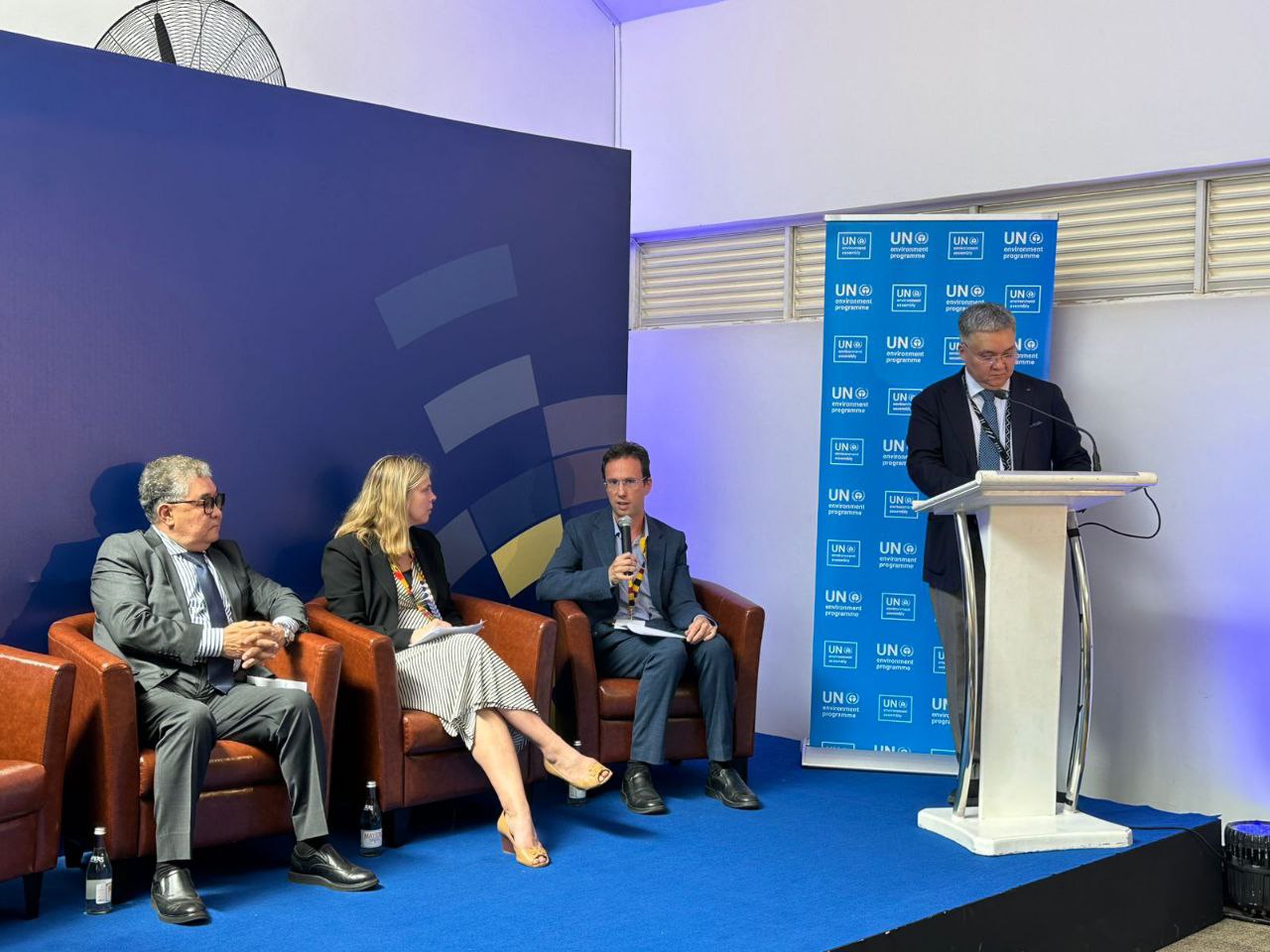
Within the framework of the seventh session of the UN Environment Assembly (UNEA-7), held from 8 to 12 December at the headquarters of the UN Environment Programme in Nairobi, a side event titled “Drying of seas and lakes – a global catastrophe of the 21st century” took place. The event brought together representatives of environmental authorities from various countries, senior leadership of UNEP, UNECE, the Secretariat of the Ramsar Convention, the International Fund for Saving the Aral Sea, financial institutions, research centres, and the expert community. During the event, Kazakhstan proposed developing a resolution on addressing the water crisis for UNEA-8.
12

Regional Ecological Summit 2026
Regional consolidation on ecology, resilience, and transboundary cooperation
Astana, Kazakhstan
22–24 April 2026
The Summit gathered more than 11,300 visits and held 58 sessions (including 21 high-level and 4 country sessions); the Declaration of the Heads of State of Central Asia was adopted

Regional Consultations

Reports and Materials on the Preparation for the RES 2026

Logo RES 02

Contacts

office@caclimate.fund

Address

11/1 Mangilik El Avenue, Office 703,

Astana, Kazakhstan

Regional Ecological Summit 2026

© All rights reserved, 2025