
Population of Rare Animals Increasing in Kazakhstan
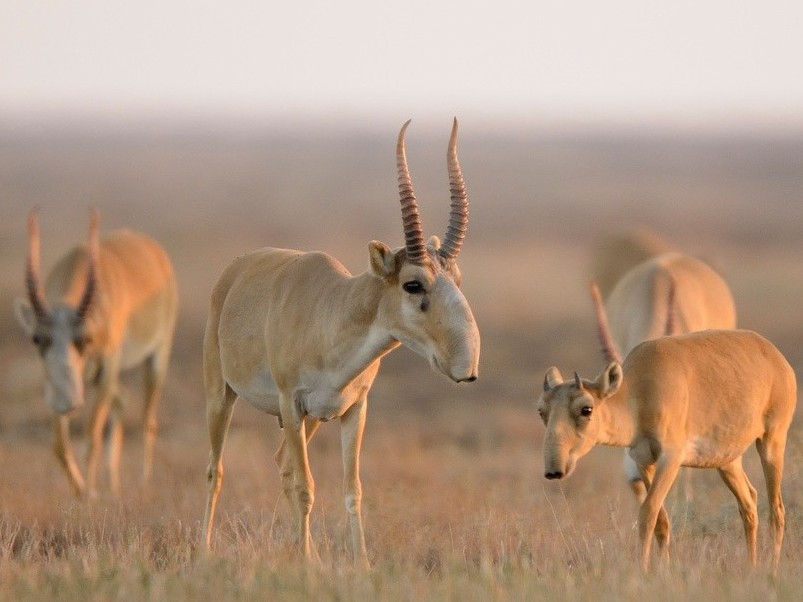
Kazakhstan is seeing an annual increase in the populations of rare ungulates and saiga antelopes. As of 2025, the population of Bukhara deer stood at 1,240, goitered gazelles at 16,122, kulans at 4,702, and argali at 17,604. The country is carrying out systematic efforts to reintroduce wild animals into their natural habitats.
According to the 2025 census, the total saiga population across all populations reached 3.978 million animals, including 2.3 million in the Ural population, 1.6 million in the Betpak-Dala population, and 78,000 in the Ustyurt population.
The Ministry of Ecology and Natural Resources of the Republic of Kazakhstan is carrying out systematic efforts to reintroduce wild animals.
As of 2025, the population of MacQueen’s bustard stood at 16,487 individuals, including 2,455 in the Kenderli-Kayasan protected area, 6,146 in the South Kazakhstan region, 1,922 in the Arys-Karatau area, 1,985 in the Zhusandala area, 470 in the Aktau-Buzachi wildlife sanctuary, and 3,491 in the Andasai wildlife sanctuary.
The Wild Ungulate Reintroduction Center, established in 2017 in the south of Kostanay Region within the Altyn Dala State Nature Reserve, currently houses 14 Przewalski’s horses (12 mares and 2 stallions). By the end of 2029, plans call for the introduction of 40 horses.
As part of efforts to restore the kulan population, 66 animals have been relocated to the Ile-Balkhash Reserve (42 animals) and the Altyn Dala Reserve (24 animals).
In addition, Kazakhstan is implementing a program to return the Turan tiger to the wild. The subspecies disappeared from Kazakhstan in the mid-20th century due to the destruction of tugai forests, hunting, and a shortage of prey. Amur tigers, which are genetically the closest to the extinct Turan subspecies, are being used to restore the population.
The main site for the predator’s reintroduction is the Ile-Balkhash State Nature Reserve in the southern Balkhash region. During the preparation period, ungulates—including kulans, goitered gazelles, and wild boars—were introduced into the reserve to establish a sustainable prey base for the tigers. In August 2026, the first Amur tigress, named Ümit, was released into the wild there.
It is worth noting that Kazakhstan is home to 835 species of vertebrates, including 178 mammal species, 489 bird species (396 of which breed in Kazakhstan, while the remainder either visit only for wintering or pass through during spring and autumn migration), 49 reptile species, 12 amphibian species, 104 aquatic species, and 3 lamprey species.
It is estimated that approximately 100,000 species of invertebrates inhabit the country, including at least 50,000 insect species.
A total of 132 species and subspecies of vertebrates and 96 species of invertebrates are classified as rare and endangered.
Hunting is permitted for 35 mammal species (including 27 fur-bearing and 8 ungulate species) and 59 bird species.
