
Weather anomalies are becoming more frequent in Kazakhstan due to climate change
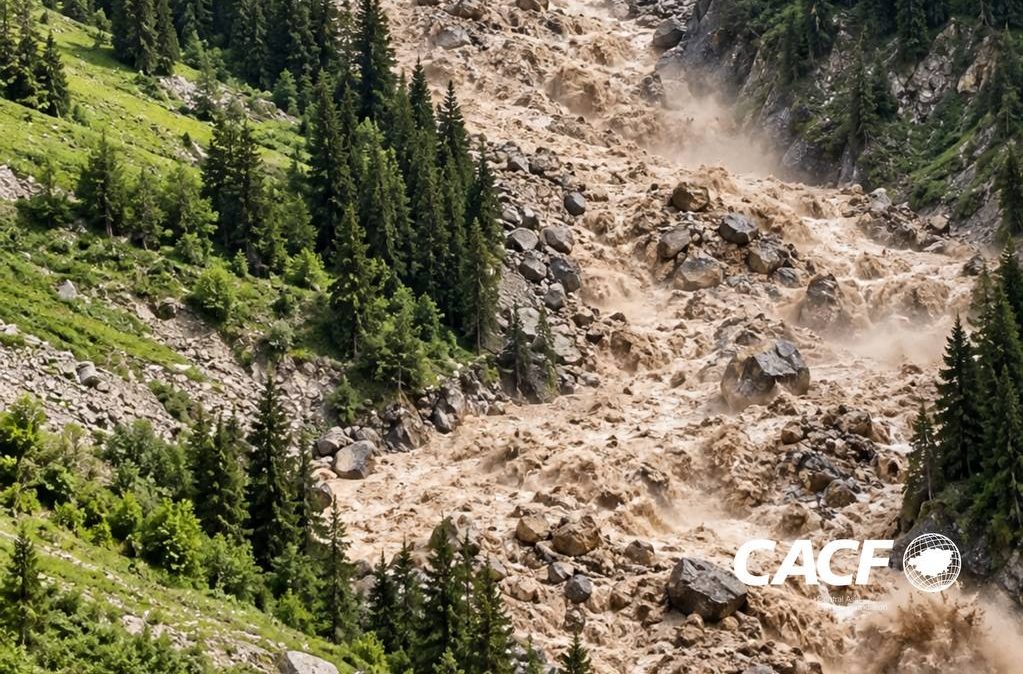
Experts from the Central Asian Climate Fund (CACF) studied the data of meteorological observations in Kazakhstan and found that over the past three years, the frequency of strong winds and rains in the country has increased 1.5 times and the number of dangerous hydrological phenomena has increased 7 times. Abnormal temperatures in summer break records every year. In the southern and western regions of the republic, the number of hot days and the duration of heat waves every 10 years increases by 3-7 days. These trends indicate that, due to global warming, the weather in the country will become more extreme every year, with an increasing negative impact on various spheres of life of the population.
After analyzing data for the periods 2020-2022 and 2023-2025 on the frequency of natural meteorological phenomena, CACF experts found that the number of cases of strong winds with a speed of 30 m/s or more increased from 225 to 339, or 1.5 times. The number of cases of strong winds in 2023 was the highest since 1990, in 2024 - the second highest.
In addition, the number of cases of heavy rain increased - from 50 cases in 2020-2022 to 75 cases in 2023-2025, as well as heavy fog - from 15 to 18 cases, respectively.
Of particular concern to experts is a significant increase in the number of dangerous hydrological phenomena (floods and low water levels, avalanches and mudflows, etc.): in 2023-2025, 179 cases were registered against 24 cases in 2020-2022. In 2025, their number was 106 cases, which is the highest value since 1990.
Moreover, extreme weather events began to occur in Kazakhstan, not typical for the territory of the republic. So, due to a tornado that swept through the Uspensky district of Pavlodar region on July 21 of this year. residential buildings, outbuildings and a power line were damaged, as a result of which several villages were left without power supply. It is worth noting that this year the hurricane wind has repeatedly damaged the infrastructure of the region, 6 people were injured.
«A tornado is a strong vortex that forms under a developed cumulonimbus cloud and spreads in the form of a giant dark cloud pillar or funnel towards the surface of the earth or sea. The tornado draws in and raises water, sand, dust, and often very heavy objects to a great height, has great destructive power. It is usually observed simultaneously with a downpour, sometimes hail.
For Pavlodar region, a tornado is not a characteristic climatic phenomenon and is observed extremely rarely. Its occurrence is possible in summer with thunderstorm activity and a wind speed of 30 m/s or more.
Modern scientific research does not allow us to draw an unambiguous conclusion that a warming climate leads to an increase in the number of tornadoes. At the same time, an increase in air temperature and an increase in atmospheric moisture content can contribute to the formation of more favorable conditions for the development of strong convection, accompanied by showers, thunderstorms, large hail and, in some cases, tornadoes», the Kazhydromet RSE explained.
At the same time, in 2023-2025, the number of cases of severe blizzard and heavy snow decreased in Kazakhstan, and the number of cases of hail and dust storm remained close to the level of the previous three-year period.
According to the RSE Kazhydromet, with global warming in our country, the duration of warm periods increases by 1.8 days/10 years, the number of days with frosts decreases by 2.8 days/10 years and with a minimum air temperature below minus 20 °C for 2.2 days/10 years.
Along with this, the number of days with a maximum air temperature of 30 °C and above in Kazakhstan increases by 2.5 days/10 years. The fastest increase in the number of hot days (from 3 to 4.4 days/10 years) is observed in the west and south - in West Kazakhstan, Atyrau, Kyzylorda, Aktobe, Mangistau, Zhambyl, Almaty, Turkestan regions and Zhetysu region, the highest trend values (6.7-7.2 days/10 years) - at meteorological stations Aktau, Aral tenisi and Peshnoi.
The number of tropical nights with a minimum air temperature above 20 °C in the country increases by 0.6 days/10 years. The greatest growth is noted in Mangistau (5 days/10 years), Kyzylorda (3.2 days/10 years), Turkestan (3 days/10 years) and Atyrau (2.7 days/10 years) regions, the maximum values (7.3-7.9 days/10 years) - at weather stations Aktau, Shardara and Fort Shevchenko.
The total number of days in heat waves in the republic increases by 2.3 days/10 years. The highest rate of increase is noted in Atyrau (4.4 days/10 years), Mangistau (4.1 days/10 years), Kyzylorda (3.7 days/10 years), Zhambyl (3.3 days/10 years), Turkestan and West Kazakhstan (3.1 and 3 days/10 years) regions, the maximum values - at the Aktau weather stations (7.3 days/10 years), Kazau ygurt (6.4 days/10 years) and Kyzylorda (6.2 days/10 years).
Considering that the summer of 2026 was the warmest in Kazakhstan and other regions of the world in the entire history of observations, as well as the forecasts of international experts, it is safe to say that abnormal temperatures and the frequency of extreme weather events will increase every year. This, in turn, will have a negative impact on various areas of people's lives, and can also cause irreparable damage to biodiversity.
«Climate change is happening much faster than people realise. And in Central Asia, in particular, due to the lack of seas, these changes will go even faster.
One thing is certain, given that the rate of global warming is not decreasing, in the future, residents of Central Asia will have to live in a new climatic reality - to endure regular heat waves and experience extreme weather events. In this regard, the governments of the countries of the region need to think about how to minimize the consequences of climate change for the population and economy. We need to prepare for this carefully and now, we do not have time to hesitate», says Temur Yunusov, CACF scientific consultant, Doctor of Biological Sciences, member of the Cambridge Forum on Central Asia.
