
How to provide Central Asia with electricity in a changing climate?
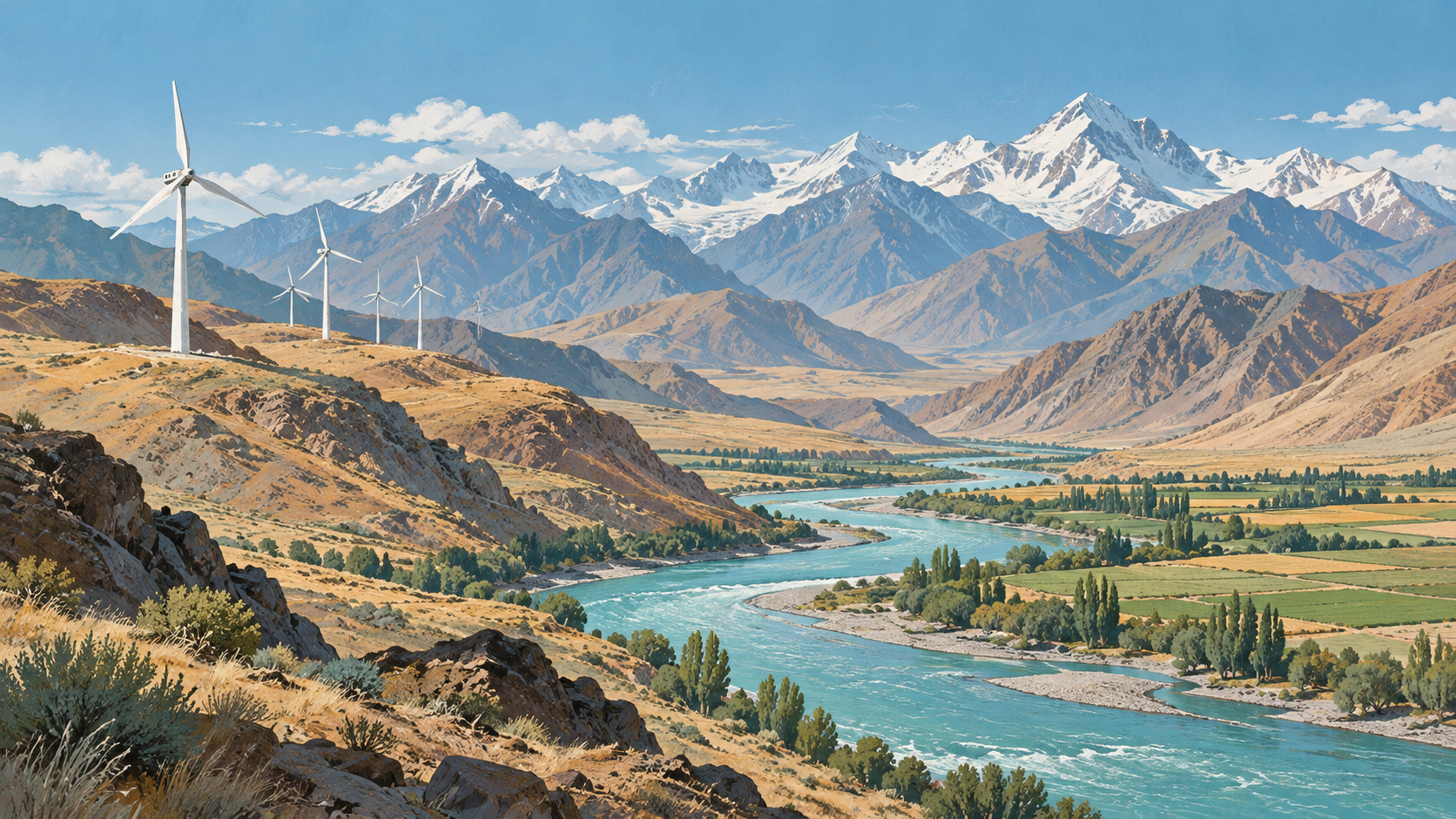
Climate change in Central Asia caused by global warming will lead to water shortages in the foreseeable future, which threatens not only food, but also energy security in the region. Temur Yunusov, scientific consultant of the Central Asian Climate Fund (CACF), Doctor of Biological Sciences, member of the Cambridge Forum on Central Asia, proposed his own solutions to the impending energy problem.
The main effects caused by climate change can be broadly divided into three key areas: rising average temperatures, increased freshwater scarcity, and extreme natural events.
Already today, most water disagreements in Central Asia are related to the production of energy by upstream countries. Tajikistan and Kyrgyzstan see hydropower expansion as a key element of their energy security and independence. However, this approach has two problems.
1. the provision of fresh water in the face of ongoing climate change is not guaranteed. Glaciers are already melting across the region. Judging by the experience of other countries, this process is currently irreversible, and trends accelerate as the ice mass decreases. For hydropower purposes, glaciers serve as the main reservoir. Although there is now no reduction in precipitation in the mountains, the water no longer freezes and does not remain as snow or ice on the peaks, but flows down, overflowing the reservoirs. For hydropower, this would mean a constant race to expand and strengthen existing reservoirs, build new ones, and build infrastructure to guard against the increased risks of dam breaches and subsequent flooding of downstream cities. In the long term, this may not be economically feasible, since the costs of building and maintaining such infrastructure may not pay off at the expense of energy generation capacity.
2. Water may be replaced by other means for the purpose of generating electricity. The expansion of solar and wind generation will not only increase the energy capacity of Kyrgyzstan and Tajikistan, but also protect their energy-generating industry from potential collapse associated with the disappearance of glaciers. However, water cannot be replaced by anything in agriculture. It is therefore wasteful to use increasingly scarce fresh water for energy production instead of agriculture.
«Both wind and solar energy have huge potential in Central Asia, but it is wind energy that has particularly high potential in the mountains of Kyrgyzstan and Tajikistan. Thanks to the topography itself, the mountains provide almost constant wind, and this is a key limiting factor for wind generation. Therefore, both countries have an advantage in this regard. In addition, there are significantly more potential sites for wind farms than for hydroelectric power plants, which means a higher potential for expanding the wind sector compared to hydropower», said Temur Yunusov.
From an economic point of view, wind farms are also more practical: hydroelectric power plants do not produce a single watt of energy until the site is prepared, the reservoir is built and filled, and the entire dam is put into operation. This means high upfront costs, large-scale changes and flooding of the area, and no energy and economic benefit until the entire project is completed, which can take decades.
Wind farms, on the other hand, begin to produce electricity from each installed turbine. They do not need to be built completely to start generation. This greatly simplifies financing: if there are funds only for the construction of half of the capacity of the wind farm, you can still build half of the capacity, which will produce half of the planned energy. It is impossible to do this with hydropower projects.
«Wind power also does not require such a large-scale change in relief and earthworks as hydroelectric power plants. In addition, it does not create strategic military targets, such as large hydropower dams. Yes, technically attacking civilian infrastructure such as hydroelectric power plants is illegal, but what does it matter in the current geopolitical realities?
Overall, reallocating funding from hydropower to wind power would be a better option, both economically and given the retreat of glaciers. At the same time, even this concept itself can become a project to strengthen regional independence and cooperation, if we develop it further», the expert emphasized.
China is already a superpower in wind power, but it is taking the industry to a whole new level with its Airborne Wind Energy (AWE) project, SAWES. It places wind turbines on a purpose-built airship to exploit high-speed, stable wind flows at high altitudes. Such a system, if developed and built with the possibility of potential consolidation in the mountains of Kyrgyzstan and Tajikistan, could not only ensure the energy independence of both countries, but also potentially turn them into regional exporters of electricity.
«My firm belief is that Central Asian countries should come together to jointly develop such technology. Do not buy this technology, namely develop it. This is important because in this case they will jointly own intellectual property rights and develop the engineering capital necessary to maintain, expand and improve such critical systems in the future. The joint nature of this initiative will also create a solid foundation for the renewal, standardization and construction of the regional high-voltage energy network that will be required to transmit this energy throughout Central Asia», said Temur Yunusov.
In his opinion, at the first stage of this project, Kazakhstan, Uzbekistan and Turkmenistan could finance the creation of a pilot installation in the mountains of Kyrgyzstan and Tajikistan. Its development would be carried out on the basis of a network of research and development centers with the participation of all countries of Central Asia, technological intellectual property would be joint and accessible to all countries of the region. The physical installations themselves would mainly belong to the host country - Kyrgyzstan or Tajikistan, and the remaining shares would be distributed proportionally among the funding countries. Host countries would pay dividends on the profits made and retain the right to buy back shares of other countries at their own discretion. This would allow host countries to gain a path to full ownership of critical energy infrastructure, while allowing funding countries to earn a certain return on energy profits while shares remain with them, and ultimately return investment in the subsequent buyout of shares by the host country.
Such a project would form a strong workforce of AWE developers and engineers, lay the foundations for the development of wind generation and a high-voltage power transmission network throughout Central Asia, and free up critical supplies of fresh water for irreplaceable use in agriculture and civilian water supply.
«If these three challenges - sustainable agriculture, water use and sustainable energy production – are addressed, it will ensure not only the long-term survival of Central Asian states in the face of climate change, but also their sustainable development. However, it is unlikely that any country can achieve this alone. In cooperation, this is achievable and at the same time strengthens the entire region», Temur Yunusov summed up.
As previously reported, experts from CACF and ESGQ Rating Agency made an analysis of climate risks for Kazakhstan's business. Having studied in detail the data of meteorological stations, satellite observations, Kazhydromet bulletins and CMIP6 scenarios, using a unique assessment methodology, experts came to the conclusion that Kazakhstan is a country with high climatic risks, which in the future will have a negative impact on the economy and quality of life of the population. For the country as a whole, 7 types of climatic hazards are relevant: heat, water stress, drought, wildfires, river floods, wind and dust storms, mudflows and avalanches. A very high and high level of risks is characteristic of 40% of the territory of the republic, where 27% of the population live.
