
The head of the CACF took part in the 5th Economic Conclave of Cautilla
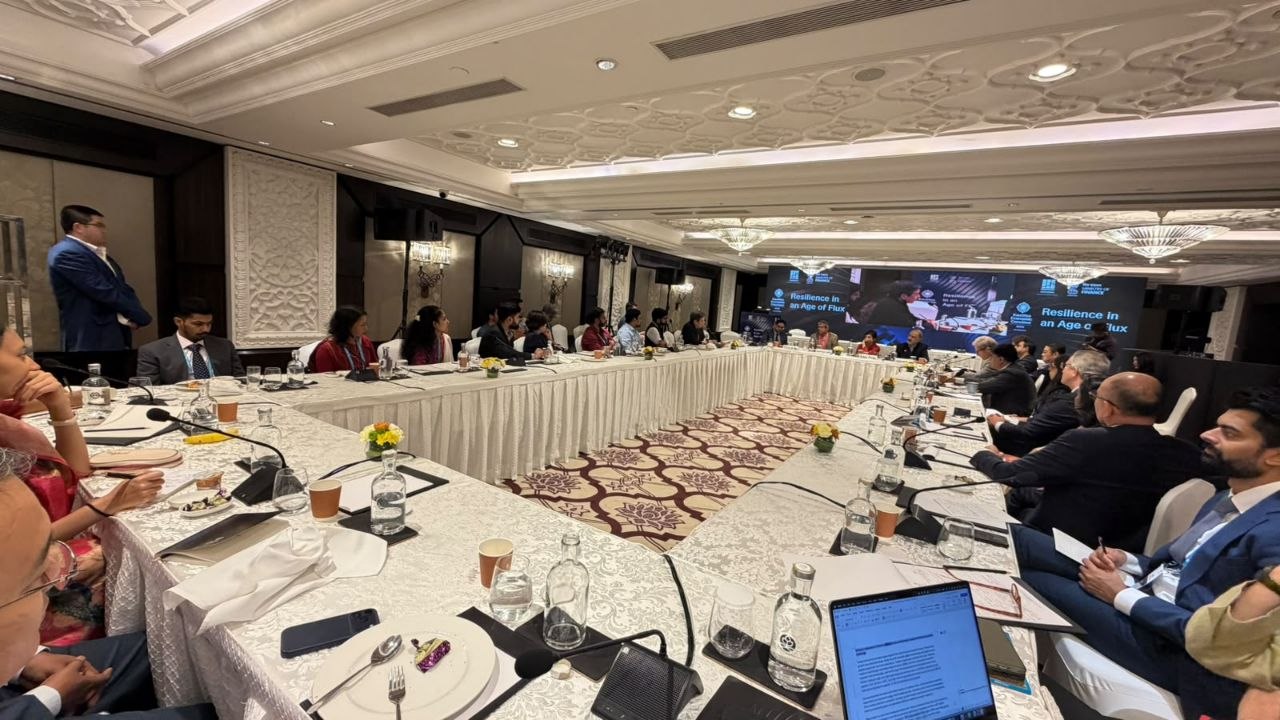
Erlik Karazhan, Chief Executive Officer of the Central Asian Climate Fund (CACF), took part in the 5th Economic Conclave of Cautilla (KEC-2026) on the theme «Sustainability in an Era of Instability». The head of CACF made a presentation «Orderly Transition», in which he stressed that transparency is the most profitable risk mitigation tool.
The event, held on October 3-5 at the Taj Palace Hotel in New Delhi, was organized by the Institute for Economic Growth (IEG) and the University of Delhi, in partnership with the Ministry of Finance of India.
KEC-2026 gathered about 300 participants on its site, including politicians, economists, scientists and financiers. Experts from some 30 countries around the world shared their views on a wide range of issues through plenary sessions, interactive side sessions, round tables and other thematic events.
Opening remarks were made by Vice President of India Chandrapuram Ponnusamy Radhakrishnan, the sessions were attended by Indian Finance Minister Nirmala Sitharaman, Indian Foreign Minister Subramanyam Jaishankar, ex-head of the European Central Bank Jean-Claude Trichet, Lord Nicholas Stern and other leading politicians and economists.
Particular attention was paid to the topics: the impact of energy crises and supply disruptions on macro management, investment and sustainability; providing central banks with financial stability in the event of volatility, technological breakdowns and repeated shocks; transforming global capital into long-term investment; development in an era of high debt, disunity and global shocks; adaptation of infrastructure, land use, finance and public services to growing climate risks; agricultural development with trade disruptions and climate uncertainty; ensuring the global safety of human health, the transition to a multipolar world and new formats of cooperation, etc.
The «Orderly Transition» lunchtime session discussed how to combine climate ambition with energy security, affordability and growth, and how public, private and multilateral finance can support orderly transition at scale.
In his speech, the head of CACF stressed that transparency is the most profitable risk mitigation tool.
«CACF together with ESGQ Rating Agency conducted scoring of 120 Kazakhstani companies based on their open data. The average score was 17.46 out of 100 possible. 77 companies at the entry level, none at the mature level, publish only 29% of the required information.
Based on the scoring results, three conclusions can be made. First, companies do not have a clear picture of their own risks that determine their business behavior, and there is almost no common data infrastructure. The second is that companies are sandwiched between predominantly Western investor expectations and government development priorities. Third, investors evaluate what they see.
Opacity is paid as a risk premium, that is, investors or creditors demand higher returns for investing in companies or projects with poor or hidden reporting. Transparency is the most profitable risk mitigation tool», said Erlik Karazhan.
The head of CACF informed the session participants about the approaches used in Kazakhstan to ensure data openness and reduce risks, and also voiced a number of proposals for interaction with India in these matters.
On the sidelines of the conference, Erlik Karazhan discussed cooperation with Lord Nicholas Stern and President of the Institute for Economic Growth (IEG) Nand Kishore Singh, and also talked with former President of the European Bank for Reconstruction and Development Suma Chakrabarti and EBRD representative Nadezhda Petkova.
The CACF chief praised the conclave's substantive level. According to him, the KEC-2026 became the site of the first row. For Kazakhstan, according to Karazhan, the main lessons of the conclave are the transition to comparable data disclosure (including according to IFRS S1/S2 standards) and a common data infrastructure as a way to reduce the cost of capital, attract long-term and climate financing through understandable «country platforms», as well as develop partnerships with India on carbon markets.
As previously reported, CACF and ESGQ Rating Agency concluded a Memorandum of Cooperation. The parties agreed that the priority areas of interaction will be the application of the ESGQ methodology for assessing ESG maturity in CACF projects, the development of methodologies for assessing climate risks, as well as joint analytical and educational products for business and government agencies in Kazakhstan and Central Asia.
