
Joint document signed in Astana by Central Asian countries and WHO on health and environmental issues in the Aral Sea region
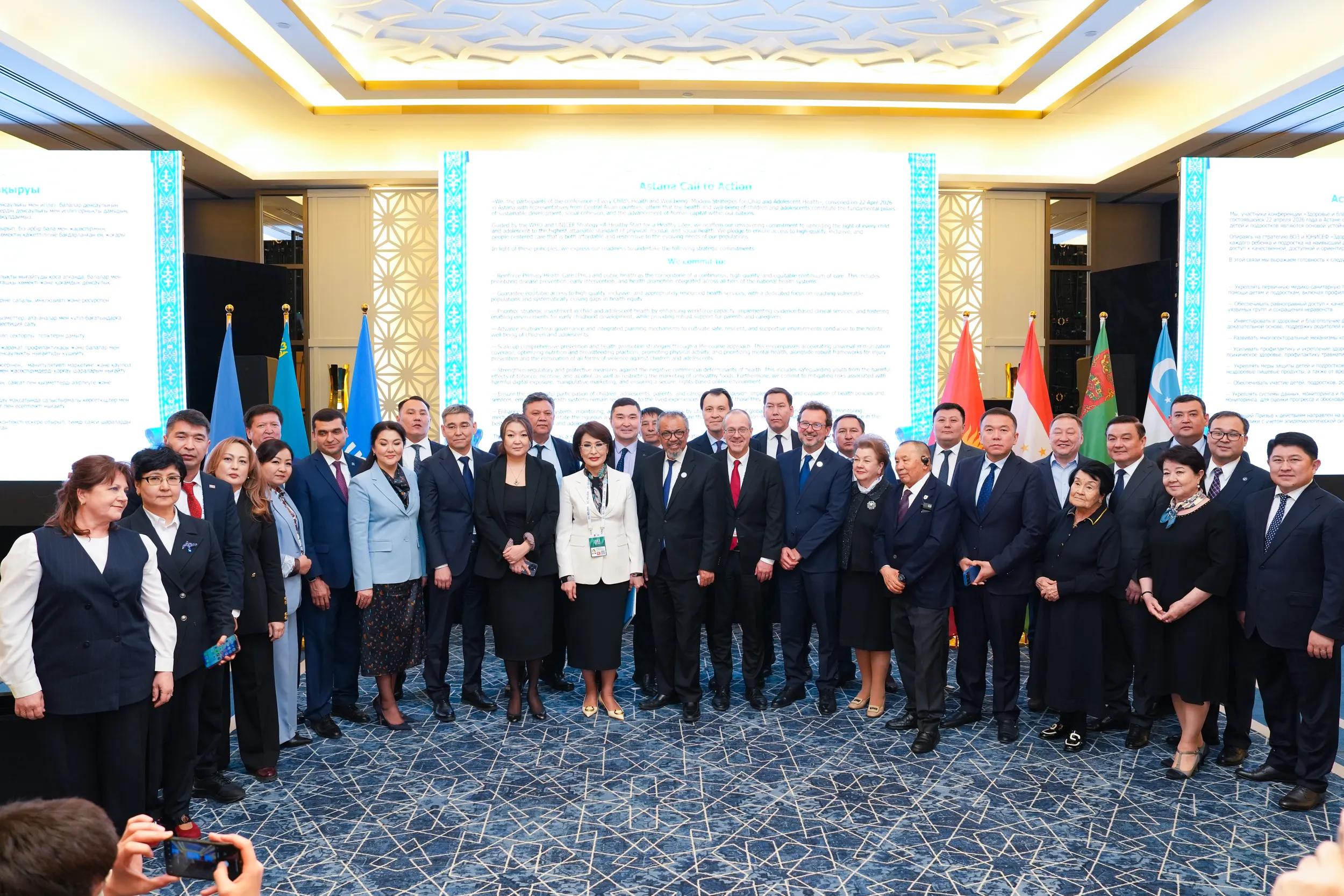
At the Regional Ecological Summit in Astana, following the panel session titled “Protecting Future Generations: Health at the Centre of the Environmental Agenda – Lessons and Solutions from the Aral Sea Basin,” a joint document was signed with the participation of the WHO Regional Director for Europe and Ministers of Health from Central Asian countries and Azerbaijan, aimed at reducing environmental risks and strengthening healthcare systems.
Deputy Prime Minister of the Republic of Kazakhstan – Minister of Culture and Information Aida Balayeva took part in the session.
The session brought together Ministers of Health from Central Asian countries and Azerbaijan, as well as WHO leadership, including WHO Director-General Dr Tedros Adhanom Ghebreyesus and WHO Regional Director for Europe Dr Hans Kluge.
“Speaking at the plenary session of the Regional Ecological Summit, Kassym-Jomart Kemelevich Tokayev clearly stated that ecology is not a narrow sectoral issue, but an ideology of development and a way of life. Responsibility to future generations, a just ecological transition, and the unifying role of international cooperation lie at its core. In this context, the ‘Taza Kazakhstan’ initiative is shaping a new environmental culture – a culture of personal responsibility, respect for nature, and civic engagement,” Aida Balayeva noted in her remarks.
A key focus of the discussion was the consequences of the drying of the Aral Sea, which has lost more than 90% of its historical volume. The environmental crisis has long-term impacts on public health, including rising rates of respiratory and cardiovascular diseases, a high prevalence of anaemia, particularly among women and children, as well as the effects of dust and salt storms.
Minister of Health of the Republic of Kazakhstan Akmaral Alnazarova emphasized:
“People’s health in the Aral Sea and Caspian regions directly depends on the state of the environment – today this is no longer only an environmental issue, but a public health agenda. We must strengthen healthcare systems so that they can not only treat, but also prevent the consequences of environmental factors. Kazakhstan is initiating the creation of a regional cooperation platform on health and environment to move from response to prevention, ensuring a sustainable future for generations to come.”
According to the Ministry of Health, more than 3 million people live in the Aral Sea region, and up to 40% of diseases are linked to environmental factors. In certain areas, anaemia rates among women of reproductive age exceed 50%, while among school-age children they reach 30–35%.
Participants in the session discussed priority measures to protect the health of future generations and presented a draft Roadmap titled “A Healthy Future in the Aral Sea Region,” aimed at reducing environmental risks and strengthening healthcare systems.
“The Aral Sea crisis reminds us that environmental degradation is not an abstract threat, but a reality faced by people, with deep and long-term consequences for public health,” said Dr Tedros Adhanom Ghebreyesus, Director-General of the World Health Organization.
“When ecosystems collapse, it is the people living in these conditions who pay the highest price. This is why health must be at the centre of the environmental agenda. I highly commend the leadership of the countries of the Aral Sea region advancing this work. WHO will support the implementation of the Roadmap “A Healthy Future in the Aral Sea Region” to ensure that future generations grow up healthier, safer, and with greater opportunities,” he added.
Following the session, a joint document was signed between Kazakhstan, Kyrgyzstan, Tajikistan, Turkmenistan, Uzbekistan, Azerbaijan, and the WHO Regional Office for Europe, formalizing agreed measures to improve public health in the region.
“The Aral Sea has lost more than 90% of its water volume. Communities living around it have paid for this with their health for decades,” said Dr Hans Henri P. Kluge, WHO Regional Director for Europe. “This joint statement is not a declaration of concern – it is a declaration of action. For too long, the health impacts of the Aral Sea crisis have been documented without an adequate response.
Today, Ministers of Health from Central Asia and Azerbaijan, together with WHO, are making a new commitment – to create a platform for cooperation and to reaffirm a shared determination to ensure that future generations in this region grow up healthier than previous ones. I am proud to sign this document and to build this future together.”
In addition, a number of memoranda were signed:
– between the Ministries of Health of Kazakhstan and Uzbekistan, with the support of the WHO Regional Office for Europe, on the development of joint initiatives, data exchange, and the implementation of the Roadmap for 2026–2029;
– between the Akimat of Kyzylorda Region, the Ministry of Health of Kazakhstan, and the WHO Regional Office for Europe under the “A Healthy Future in the Aral Sea Region” initiative;
– between the Akimat of Atyrau Region, the Ministry of Health of Kazakhstan, and the WHO Regional Office for Europe on conducting joint research, strengthening monitoring systems, and promoting the “One Health” approach.
The panel session served as an important platform for developing coordinated solutions aimed at reducing environmental risks and strengthening public health in the region.
