
Green Shield of Central Asia: Regional System of Protective Forest Belts and Green Barriers (2026–2035)
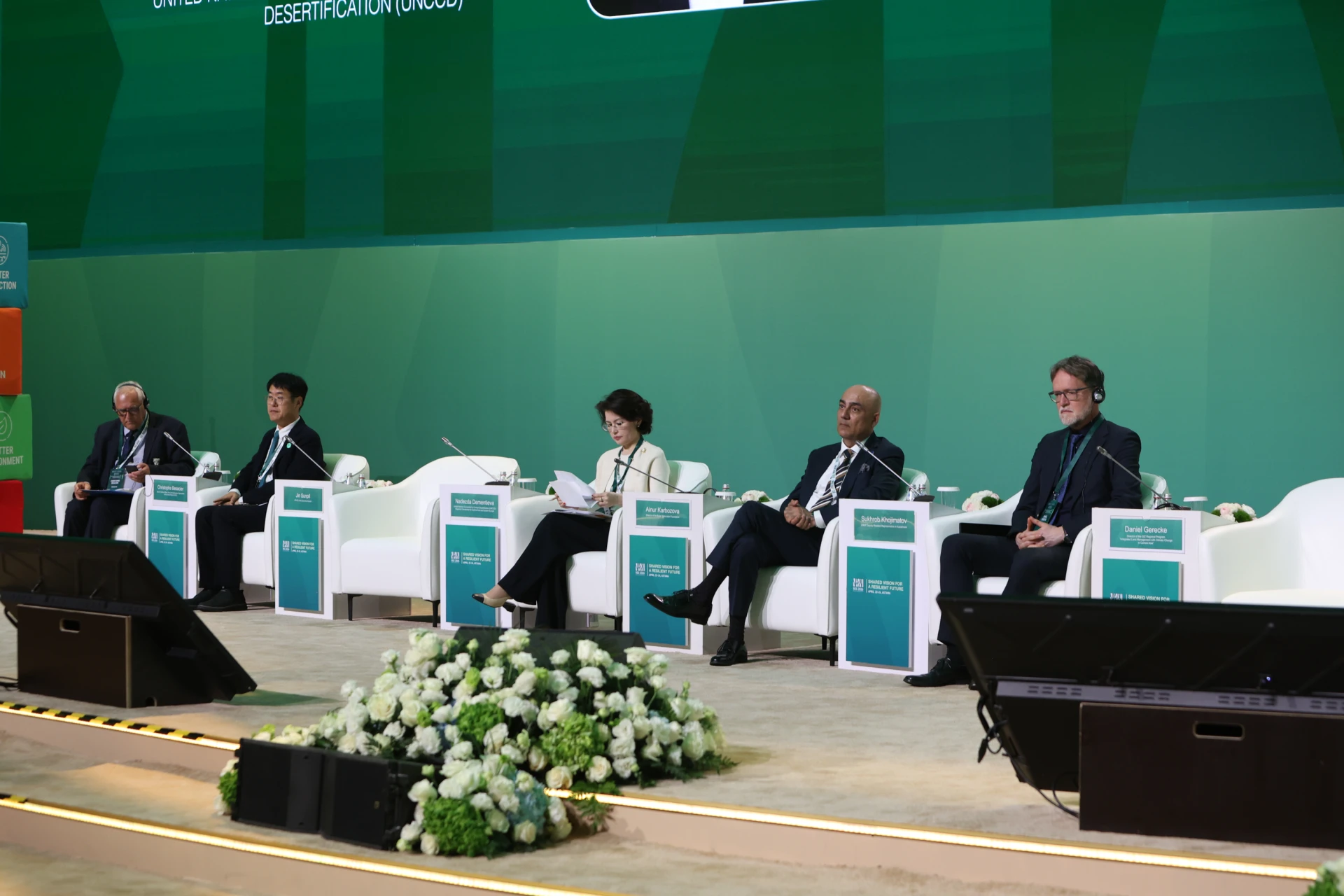
Within the framework of the Regional Ecological Summit 2026, a panel session titled “Green Shield of Central Asia” was held, during which issues related to the formation of a regional system of protective forest belts and green barriers against land degradation and dust storms were discussed.
Kazakhstan proposed launching the “Green Shield of Central Asia” initiative, not as a one-time greening campaign, but as a foundation for the long-term ecological sustainability of the region.
Our country has experience in reforestation and forest creation under challenging natural and climatic conditions. One of the most illustrative examples is the forest belt around the capital. Since 1997, a unique project has been consistently implemented here, and today the area of established forest plantations amounts to 102 thousand hectares.
“This result confirms that even in areas previously unsuitable for forestry, ecosystem restoration is possible when relying on science, long-term planning, and the professional work of foresters,” noted the Minister of Ecology and Natural Resources of the Republic of Kazakhstan, Yerlan Nyssanbayev.
Kazakhstan is already forming a “green framework” of the country. On the instruction of the Head of State, a large-scale greening program is being implemented, involving the planting of 2 billion trees in the state forest fund and 15 million trees in populated areas.
One of the largest ecological problems of our time remains the Aral Sea. The total area of the dried seabed is about 6 million hectares, of which 2.8 million hectares are located in Kazakhstan. Since 2021, large-scale phyto//forest//melioration has been carried out on the dried seabed of the Aral Sea.
“To date, saxaul plantations and other salt-resistant species have been established on an area of more than 1.1 million hectares. This is not only a national project. It is a contribution to reducing transboundary dust storms, stabilizing the regional ecological situation, and improving living conditions for the population of neighboring countries,” the minister shared.
Despite the achieved results, dust and sand storms are becoming increasingly frequent in the western regions. The main hotspots are located in the Aral Sea region, Moiynkum, the North Caspian zone, and Aktobe region.
According to scientists, in Central Asia, 9 square meters turn into desert every minute, shared in his opening remarks by the Advisor to the President of the Republic of Uzbekistan on Ecology – Chairman of the National Committee on Ecology and Climate Change of the Republic of Uzbekistan, Aziz Abdukhakimov.
One of the most effective tools in combating land degradation is the formation of a system of protective forest belts. In this regard, Kazakhstan proposes launching an initiative to create a regional system of protective forest belts, the “Green Shield of Central Asia.”
“Together with colleagues from Central Asia, significant preparatory work has already been carried out: a draft resolution has been prepared and sites for creating forest plantations have been identified. The participants of the initiative include Kazakhstan, Uzbekistan, Turkmenistan, Tajikistan, and the Kyrgyz Republic. As key international partners, we consider relevant international organizations and ecological funds,” said Minister Yerlan Nyssanbayev.
This initiative is directly linked to the Sustainable Development Goals, including food security, climate change adaptation, sustainable natural resource management, and the development of regional partnership.
Kazakhstan proposes not only a political declaration, but also a practical mechanism — a project with measurable parameters, implementation stages, and a monitoring system.
“Each country determines its own priority areas. Together, they form a unified regional system of green barriers capable of changing the ecological dynamics of Central Asia,” noted Yerlan Nyssanbayev.
Kazakhstan is already implementing one of the largest greening programs in the region. The next step is the transition from a quantitative increase in plantings to the formation of a systemic protective infrastructure.
The discussion was attended by representatives of Kazakhstan, China, Central Asian countries, as well as FAO, UNDP, GIZ, AFoCO, UNCCD, and other international partners.
For the Kazakhstan side, the session is important as a practical platform for strengthening regional cooperation in the field of reforestation and attracting international financial and expert support.
Following the session, the parties agreed on the key directions of the initiative and also signed the Resolution “Green Shield of Central Asia.”
